
Towing Capacity Explained: GVWR, GCWR and Payload
GVWR, GCWR, payload, and tongue weight explained in plain terms, with the formulas and a calculator to find your real towing limit before you hitch up.
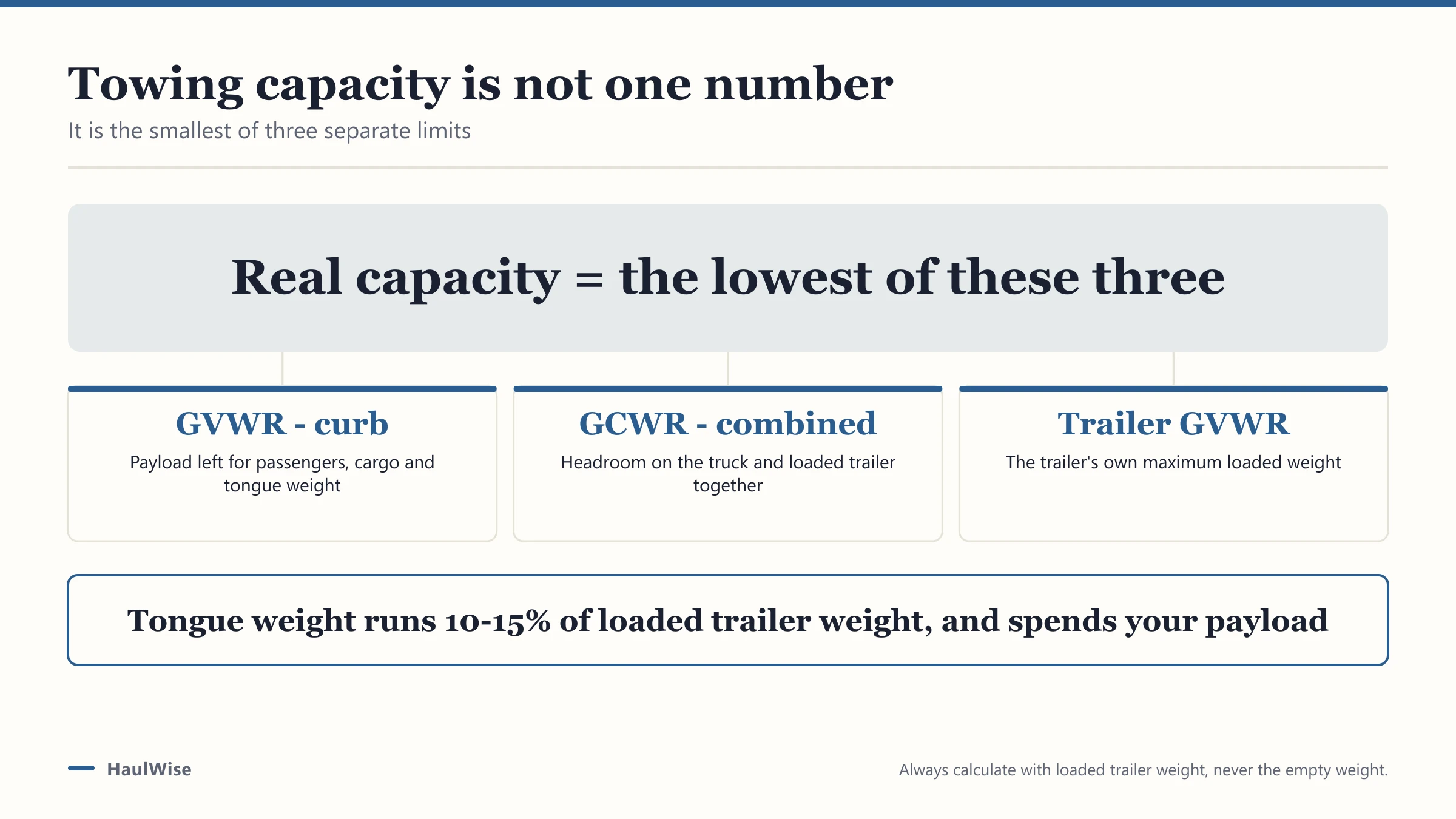
Every truck ad quotes one big towing number. That number only applies to one specific configuration, usually the lightest cab, the smallest engine’s beefiest trim, empty of passengers and cargo. Your actual limit is defined by three separate numbers working together, and the smallest one wins.
What is GVWR?
GVWR, or Gross Vehicle Weight Rating, is the maximum a vehicle can weigh fully loaded, including its own weight, fuel, passengers, cargo, and tongue weight from a trailer. It is not how much the vehicle weighs empty (that is curb weight) and it is not how much it can tow (that is a separate rating). GVWR minus curb weight equals payload, the number that actually limits how much tongue weight and cargo you can carry at once.
What is GCWR?
GCWR, or Gross Combined Weight Rating, is the maximum combined weight of the tow vehicle and a loaded trailer together. This is the number that catches people who check only the trailer’s advertised towing capacity: a truck can be rated to tow 9,000 lbs and still be over its GCWR if the truck itself is loaded with passengers, a full tank, and gear. GCWR always sits above GVWR alone, since it accounts for both vehicles at once. Our GVWR vs GCWR guide breaks down exactly how the two interact.
What is payload?
Payload is the total weight a vehicle can carry, cargo, passengers, and trailer tongue weight combined, calculated as GVWR minus curb weight. Payload is the most commonly ignored number in towing math, because tongue weight from a trailer counts against it just like a truck bed full of gravel does. A truck with a high advertised towing capacity but a light-duty payload rating can still run out of margin before the trailer’s own limit does.
How do the three numbers work together?
| Term | What it measures | Formula | Where to find it |
|---|---|---|---|
| GVWR | Max loaded weight of the tow vehicle alone | Fixed rating | Door-jamb sticker |
| Payload | What the vehicle can carry (cargo + passengers + tongue weight) | GVWR minus curb weight | Calculated |
| GCWR | Max combined weight of vehicle plus loaded trailer | Fixed rating | Door-jamb sticker or owner’s manual |
| Towing capacity | Max trailer weight, assuming a lightly loaded tow vehicle | GCWR minus curb weight (roughly) | Manufacturer spec, verify against GCWR |
Your safe towing number is whichever of these runs out first. A half-ton truck with a big advertised towing number but a modest payload rating, loaded with four passengers and a full bed, can hit its payload ceiling well before it reaches the trailer’s rated weight.
What is tongue weight, and why does it matter here?
Tongue weight is the downward force the trailer’s coupler puts on your hitch, and it should run 10-15% of the trailer’s loaded weight for a standard weight-carrying or weight-distributing hitch, or 15-25% for a gooseneck or 5th-wheel setup. Tongue weight counts directly against your payload, not your towing capacity, which is why two trailers of the same total weight can affect your margin differently depending on how the load sits. Our tongue weight guide covers how to measure it and what happens when it runs too low or too high.
How do I check my exact numbers?
Start with the door-jamb sticker on your specific vehicle, not a brochure or a forum post, since GVWR, GCWR, and payload vary by trim, cab size, and options package even within the same model year. Once you have GVWR, GCWR, curb weight, and your trailer’s loaded weight, our towing capacity calculator runs the payload check, the GCWR check, and the tongue-weight percentage together and gives a plain pass, caution, or over-capacity verdict. If you drive one of the most-towed trucks on the road, our Toyota Tacoma towing capacity guide has year-by-year and trim-by-trim numbers already worked out.
What is the CDL threshold for towing?
Once the combined GVWR of your tow vehicle and trailer crosses 26,001 lbs, most states require a commercial driver’s license or a non-commercial Class A license, depending on the state. This threshold matters most for gooseneck trailers and heavy dump or flatbed loads, where combined weight climbs fast; always confirm the specific rule in your state before you buy a trailer that pushes you close to that line.
What mistakes do first-time towers make with these numbers?
Checking towing capacity but skipping payload. This is the single most common error. A truck can have room left on its towing capacity and still be out of payload once the tongue weight, a full cab of passengers, and a bed full of gear are added up.
Using the trailer’s empty weight instead of loaded weight. A dump trailer might weigh 3,000 lbs empty and 9,000 lbs loaded with gravel. Every calculation in this guide uses loaded weight, since that is the number that actually stresses the tow vehicle.
Assuming every trim of the same model tows the same amount. Cab size, axle ratio, engine choice, and factory tow packages all change GVWR, GCWR, and payload, sometimes by thousands of pounds, within the same model year. The Toyota Tacoma towing capacity guide shows how wide that spread can be on a single, widely towed truck.
Forgetting that fuel, water, and gear add up fast. A full tank of diesel can weigh 150-200 lbs on its own; a generator, tools, and a cooler in the bed add more. None of that shows up on a spec sheet, but all of it counts against payload the moment it is loaded.
Getting the real number before you shop
Towing capacity is not a single fact you can look up once. It changes with every passenger, every full tank, and every trailer you hitch. Work through GVWR, GCWR, and payload for your specific vehicle configuration, check tongue weight on the trailer you are considering, and confirm the combined total against your GCWR before you sign for anything. The towing capacity calculator does all three checks in one pass once you have the numbers off your door sticker.
Frequently asked questions
Quick answers to what readers ask us most
What is the difference between towing capacity and payload?
Payload is how much weight your vehicle can carry inside it or on the hitch, cargo, passengers, and tongue weight combined. Towing capacity is how much your vehicle can pull behind it. Tongue weight from the trailer counts against payload, which is why a fully loaded truck bed can quietly eat into your towing margin.
Does towing capacity include the weight of passengers?
No. The advertised maximum towing figure assumes a lightly loaded vehicle, sometimes just a driver. Every passenger, cooler, and toolbox in the vehicle reduces the payload available for tongue weight, which can drop your real safe towing number well below the advertised max.
How do I find my exact towing capacity?
Check the door-jamb sticker for GVWR, GCWR (if listed), and curb weight, then run those numbers through our towing capacity calculator along with your trailer's loaded weight. That gives a specific pass or fail instead of a generic brochure number.
What happens if I tow over my rated capacity?
Overloading strains the transmission, brakes, and frame, increases stopping distance, and can cause sway or loss of control. It also voids warranty coverage in many cases and can affect insurance claims after an accident, since GVWR and GCWR are treated as legal limits, not suggestions.