
Dump Trailers for Sale: Complete Buying Guide
How to choose a dump trailer by size, GVWR, and gate style, with price tiers from homeowner-size units to heavy contractor trailers rated to 14,000 lbs.
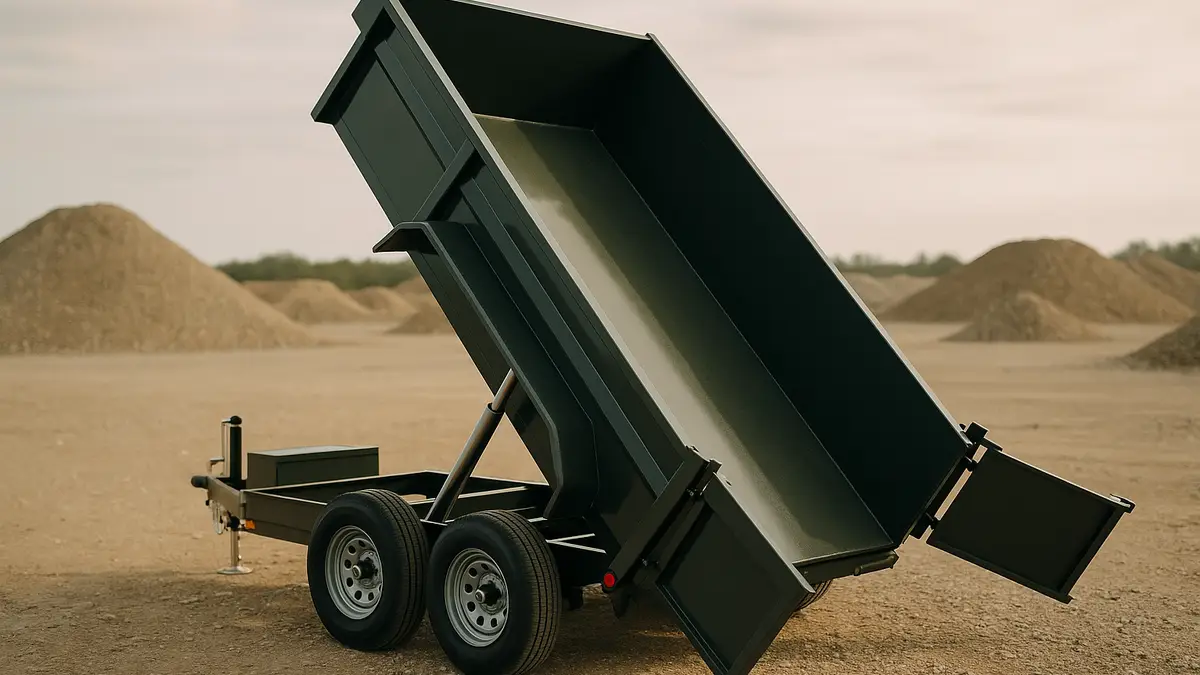
A dump trailer looks simple until you are staring at a lot full of them, all claiming to hold “a few yards” of material. The number that actually matters is GVWR, and it decides both how much you can legally haul and how much you will pay. For the full decision tree across every trailer type, start with our trailer buying guide.
What size dump trailer should you buy?
Dump trailers run 6x10 to 7x16 ft with GVWR from 7,000 to 14,000 lbs, and the right size comes down to what you are hauling and how often. Homeowners doing occasional mulch, debris, or gravel runs are well served by the small end of that range. Landscapers, small contractors, and anyone hauling material weekly should size up to a tandem-axle trailer, both for the extra payload and for the stability a second axle adds when the trailer is loaded unevenly.
Dump trailer tiers by price and capacity
| Tier | Size | GVWR | Typical price (new) | Best for |
|---|---|---|---|---|
| Homeowner | 6x10 ft, single axle | 7,000 lbs | $6,500-$8,500 | Yard debris, occasional gravel or mulch runs |
| Small contractor | 7x12 to 7x14 ft, tandem axle | 9,990-12,000 lbs | $8,500-$11,500 | Landscaping crews, weekly material hauling |
| Heavy contractor | 7x14 to 7x16 ft, tandem axle | 12,000-14,000 lbs | $11,500-$14,000 | Daily hauling, construction debris, heavier aggregate loads |
Homeowner tier. A 6x10 single-axle dump trailer is the entry point, light enough for a mid-size truck or SUV to tow and small enough to store beside a garage. This tier is not for anyone hauling wet material or dense aggregate regularly; the payload margin runs out fast once you’re moving 2,000+ lb-per-yard material more than a couple times a month.
Small contractor tier. A 7x12 or 7x14 tandem-axle trailer is the workhorse size for landscaping and light construction, with enough payload to move a full yard of gravel or two of mulch per trip without babying the axles. This tier is not for anyone who only needs a trailer a handful of times a year; the price premium over the homeowner tier only pays off with regular use.
Heavy contractor tier. 7x16 ft trailers rated up to 14,000 lbs are built for daily commercial use, hauling dense material like crushed stone or wet debris at volume. This tier is not for occasional users or anyone towing with a half-ton truck; the tow vehicle needed to safely pull a loaded 14,000 lb trailer usually means a heavy-duty pickup with a GCWR well above what most consumer trucks carry.
How much does material actually weigh?
This is the number that catches new buyers off guard: dump trailers sell on visual capacity (cubic yards) but are limited by weight (GVWR). Loose dirt and gravel run roughly 2,000-3,000 lbs per cubic yard, mulch runs lighter at 400-800 lbs per yard, and wet material weighs meaningfully more than dry. A trailer that looks like it holds “3 yards” of gravel by volume may only carry 2 to 2.5 yards once you account for its actual payload capacity (GVWR minus empty trailer weight).
Hydraulic lift: battery vs PTO
Nearly all dump trailers sold today use a battery-powered hydraulic pump rather than a truck’s power take-off, since it works independent of the tow vehicle and lets you dump with the trailer already unhitched. Look for a deep-cycle battery, a charger included in the price, and a scissor-lift or telescopic-cylinder mechanism rated for the trailer’s full GVWR. Telescopic cylinders generally lift a fuller load at a steeper angle, which matters for sticky material like wet clay.
Gate style: barn doors vs spreader gate
A barn-door (swing-open) gate dumps material in a controlled pile, useful for gravel drives and precise placement. A spreader gate opens to a set width and drags material into an even layer as the trailer moves forward, useful for spreading gravel or soil over a driveway or path in one pass. Most contractor-grade trailers offer both in a combination gate; homeowner-tier trailers more often ship with barn doors only.
Steel vs aluminum: does the frame material matter?
Nearly every dump trailer on the market is steel, and for good reason: steel handles the repeated flex and impact of loading gravel, rock, and debris better than aluminum at a comparable price. Aluminum dump trailers exist but are rare and command a real price premium, mainly useful where corrosion resistance (coastal areas, road salt) outweighs the extra cost. For most buyers, a steel frame with a quality powder-coat or e-coat finish, checked and touched up yearly, holds up fine and costs meaningfully less than aluminum at the same GVWR.
What should you check before buying new?
Compare the warranty on the frame versus the warranty on the hydraulic components separately; frames commonly carry longer coverage than pumps and cylinders. Check the axle brand and rating (Dexter and Lippert are common, widely serviced names) rather than an unbranded axle that may be harder to source parts for later. Confirm the tire load range matches the GVWR with margin, not just the minimum rating; our trailer tires guide covers matching load range correctly.
Do you need a dump trailer or a utility trailer?
If you are hauling loose material that needs to be unloaded by tipping rather than lifting or sliding off, a dump trailer earns its price premium over a flat utility trailer. If your loads are mowers, ATVs, or boxed cargo rather than loose aggregate, a utility trailer costs less and covers more use cases. Our dump trailer vs utility trailer comparison walks through the decision in more detail.
Before buying, confirm your tow vehicle can handle the loaded weight, not the empty trailer weight; a loaded 12,000 lb tandem dump trailer needs real GCWR margin. Run your numbers through our towing capacity guide, and check your state’s brake requirement in our trailer brakes guide before you tow a loaded trailer home.
Frequently asked questions
Quick answers to what readers ask us most
What size dump trailer do I need?
For occasional homeowner use (mulch, yard debris, a few loads of gravel a year), a 6x10 or 6x12 trailer around 7,000-9,000 lbs GVWR is plenty. For weekly landscaping or small-contractor work, a 7x14 tandem-axle trailer rated 10,000-14,000 lbs handles heavier, more frequent loads without excessive trips.
How much weight can a dump trailer actually carry?
Payload equals GVWR minus the trailer's empty weight, commonly 2,500-4,000 lbs, so a 10,000 lb GVWR trailer might carry roughly 6,000-7,500 lbs of material. Dirt and gravel weigh 2,000-3,000 lbs per cubic yard loose, so a 7,000 lb payload caps out around 2.5-3.5 cubic yards, well under the trailer's visual capacity.
Do dump trailers need brakes?
Most states require brakes on at least one axle once trailer GVWR crosses 3,000-5,000 lbs, which covers nearly every dump trailer on the market. Confirm your specific state's threshold; see our trailer brakes guide for electric vs surge options.
Is a dump trailer or a dump truck body better for occasional use?
A dump trailer is almost always the better choice for occasional or seasonal use, since it detaches and stores out of the way, works behind any sufficiently rated tow vehicle, and costs a fraction of a dedicated dump truck. Dump truck bodies only make sense for daily commercial hauling.